mentoring4u

Schlagwort: Future

  • Challenge 2014 for Students from African-Universities

    During semester 2014 Mentoring4u – Haus der Mentoren gGmbH  – sets up a monthly competition „Students abroad“

    Students from African-Universities who enjoy writing, telling stories or writing about their studies, his/her intention are invited to join.

    The topic is determined by you. Surely the topic will be about the future, jobs and opportunities – all topics concerning you and the world today.
    Publication
    the text is written by you and we will publish it immediately on www.mentoring4u.de .
    Attention your text will reach a good review on the website if you send your article in as soon as possible.

    Students from african universities will win!
    The price is a combination of stars and the judgment of the jury (40:60). The author receiving the most stars on his/her article published on www.mentoring4u.de has a good chance to win, butbe reminded of the jury.

    What can you win?
    Haus der Mentoren gGmbH will be looking for a personal mentor.

    Your Text and the Text Language
    The file should have the length of about one half to one page DIN A4 (4,500 characters). You can write in German, English, French, Turkish, and Spanish and send it to:

    redaktion@mentoring4u.de

    Photos
    with good pictures you will have a good chance. The photos should show you and not the faces of others. The images can be either painted or photographed.

    Finally,
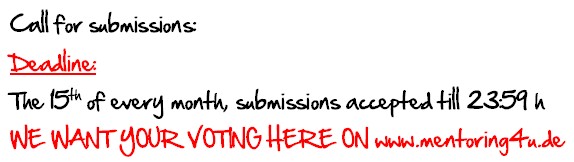
    during the following months, your new article must arrive always until the 15th. The voting will run until the last day of the month.

    Follow us via Twitter:  @HouseofMentors , @mentoring4u.de

    (Project Director: Martin Weiss | Foto: jomi | Quelle: photocase) )

  • Hussein Hassanin, Cairo, Egypt 2: Solutions

    (1)working hours in the public and private sector should be reduced to a maximum of 30 hours and 40 hours per week respectively, thereby creating jobs for the unemployed under-25s years old of young people. (here, there should be no decrease in the pay of those currently employed)..  in the meantime , the young new workers should be paid a minimum wage at the current rate..

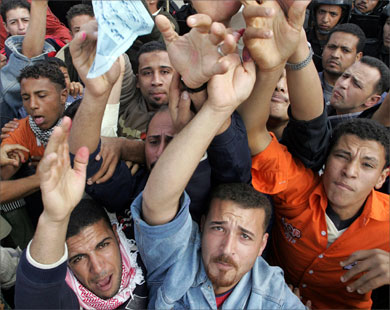
    chanting for work in Egypt

    (2) It is time the government reintroduced the Future Jobs Fund or something similar, as it provided real jobs for young people.

    (3)There is an advice to all such young people is to make sure they immediately contact their local union and ask about organising in their workplace. If they can persuade their colleagues to become unionised, they can then fight together for proper wages and conditions ..

    (4) Build more housing: A national house-building programme would immediately create jobs as well as address our long-term housing crisis. first we need to build the housing in those areas where jobs are being created..Second, we have to find wayout about restraining buy-to-let investors who have dominated house-buying..

    (5)Rebalance tax breaks: We must make it attractive to invest in young people. Young people need a level playing field with older workers in the job market.

    (6) Meet the challenge of globalization: Much of Germany’s growth, and other rich European countries’s growth in the past decade has been assisted by economic migration from other countries, but this has also forced young adults new to the labour market on to the back foot. Where once the state promised „full employment“, it couldn’t deliver that pledge even if it dared make it the era of globalisation. The charges to compete on the global stage must be abolished and the older generation – and the richest among them – must stump up their cash to fund the challenge.

    (7) Address the tax haven culture: just as workers have been pulled into Germany and other rich European countries, money has poured out. The wealthiest individuals and companies in some European countries shelter their money untaxed in foreign havens that don’t meet even rudimentary regulatory standards. Those countries need global democratic institutions to ensure that more capital is invested in the interests of the future.

    (8) Focus on the long term: Short-term logic underpins much of governments policy. To sell off assets, realise the cash and fail to reinvest is plainly robbing the next generation. Young adults need job security as much as older ones, so if co-operative and mutual institutions are more likely to invest in their employees as well as their businesses and deliver that security, aren’t these what governments should incentivise with tax breaks, grants and endowments?…

    Finally, I believe that is just a stab at a set of proposals to get our young adults back on their feet – and the economy, too.

    Link to Part 1(Problems)

    (Guest author: Hussein Hassanin, Cairo, Egypt  / Picture: Hussein Hassanin)

  • Hussein Hassanin, Cairo, Egypt: The future for our young people: problems and solutions:

    *We are aware that the problem of the future of young people is something that may seem impossible. But this should not take us to the resignation and inaction. The principle of personal responsibility and the ability of each person are inalienable values.

    chanting for better life in Egypt

    The younger generation suffering from the four letter words (neet) wors, which is (not education, employment, and training)..

    *We can see it in the current economic crisis, which makes us fear for our future and for the future generations.  The young live intensely the current crisis. Links with the family are crucial to many of them in these times. But the big problem of youngsters is without doubt the difficulty of finding work. One of every two young people(other countries one of every five) looking for work can’t find it and is unemployed, situation which affects more than 50% of this group, a terrifying number. For our young people, it is very difficult to get credit to start an activity or to buy a home and become independent and found a family, because they cannot provide warranties that are asked for.

    *Some young people do not hesitate immigrate to countries where they can work. This, which is a solution for those who live it, is without doubt a notable loss for the country, because those who leave are often those who are most ready and could make a greater contribution to our society

    *indeed, some countries suffered from the deliberate deindustrialization pursued by some governments in early 1980s, 1990s.. Whole swaths of manufacturing industry disappeared.. There used to be proper apprenticeships for young people, in engineering, textiles, mining, shipbuilding and other industries, but now mant of them disappeared.

    Business leaders talk of a skills shortage, when they actually caused it themselves by not training a new generation of youngsters. They preferred to put short-term profit before the long-term interests of their own businesses.

    Some other business men transferring manufacturing to the far east on cost grounds, in this cases it will never solve employment problems.

    Solutions:  *some experts suggest some ideas to help the younger people: …….

    Link to Part 2: Solutions

    (Guest author: Hussein Hassanin, Cairo, Egypt  / Picture: Hussein Hassanin)

  • Was können Eltern Ihren Kindern heute empfehlen? Diskutieren Sie mit uns

    Messe Menschen von oben
    Die Finanzkrise hinterlässt tiefgehende Strukturbrüche in Volkswirtschaften, Wirtschaft und Gesellschaft. Die Staaten haben in bisher ungeahntem Ausmaß eingegriffen. Neue Rahmenbedingungen sind gesetzt worden, vor allem aber, es findet eine fast unermessliche Lastenverschiebung auf die nächsten Generationen statt.

    Vertrauen und Zuversicht in die eigenen Kräfte und der Gesellschaft schwinden.

    Sprüche wie „Du sollst es einmal besser haben als wir“ und „Dir steht die Welt offen“ sind für junge Menschen keine Unterstützung, um in der nach außen desolat scheinenden Wirtschaft und im Wirrwar von offenen Ausbildungsplätzen, Studiengängen und Fachkräftemangel die richtige Entscheidung zu treffen.

    Was können Eltern, Wissenschaftler, Manager und Politiker jungen Menschen heute empfehlen? Diskutieren Sie mit uns.

    (M. Weiss | Foto: stm | Quelle photocase)